Carbonation Stone Check Valve
Construction, installation, servicing, and chemical compatibility of the BrewWizz check valve for carbonation stones.
The BrewWizz check valve sits in the CO₂ line to the carbonation stone and prevents product from flowing back up the line. It is fully serviceable: the inner plug and duck bill valve can be replaced if worn or damaged.
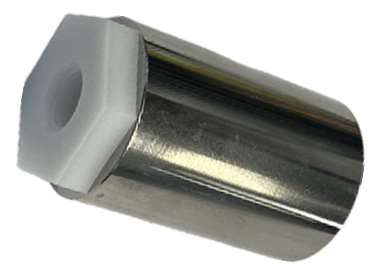
The check valve: stainless steel outer body with the white Delrin inner plug.
Construction
| Component | Material | Notes |
|---|---|---|
| Outer body | 304 stainless steel | Machined and polished |
| Inner plug | White Delrin (acetal) | Approved for direct food contact, replaceable |
| Duck bill valve | Silicone | Approved for direct food contact, replaceable |
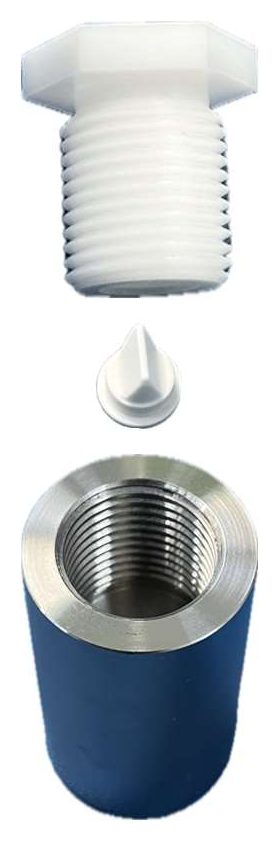
Exploded view, top to bottom: inner plug, duck bill valve, outer body.
Connections: both ends have standard ¼ in FNPT threads. Seal these connections with plumber's tape or a food-grade epoxy weld.
Factory epoxy welds: on assemblies built by BrewWizz, the NPT threaded joints (CO₂ connection, isolation valve, check valve, elbow and stone adaptor) are sealed with an "epoxy weld": Max Clear epoxy made from NSF food-safe ingredients, applied to the threads and fully cured before shipping. Every epoxy-welded assembly is leak tested before it leaves the factory.
- An epoxy-welded joint will not come undone without a wrench. Don't try to take it apart; contact Support & Parts if a joint leaks.
- A small bead of epoxy visible at the neck of a joint is normal and shows the weld is complete.
- The epoxy on welded joints may have an amber or yellow tint. This is normal ageing of the epoxy and does not affect the seal.
Thread lock: the inner plug is secured in the outer body with T42 SAF-T-LOK Blue (24202). Any medium-strength thread lock can be used instead, because the flange of the duck bill valve seals the inner plug threads from the beverage.
Size: approximately 2 3/8 × 1 7/16 in (6.0 × 3.7 cm).
Cleaning: the check valve can be cleaned using the torpedo method. See Chemical compatibility before choosing a cleaner.
Installation
Assemble the parts in this order, from the CO₂ supply down to the tank:
CO₂ connection
Ideally an industrial push-to-connect fitting.
Isolation valve
Install so that the handle covers the CO₂ connection when the valve is in the On position.
Check valve
Mounted vertically, directly below the isolation valve.
Elbow
Turns the line toward the tank port.
Carbonation stone
Connected through the elbow to the tank.
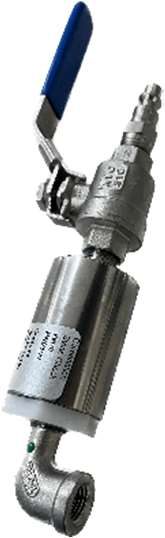
Assembly order, top to bottom: CO₂ connection, isolation valve, check valve, elbow (to the carbonation stone).
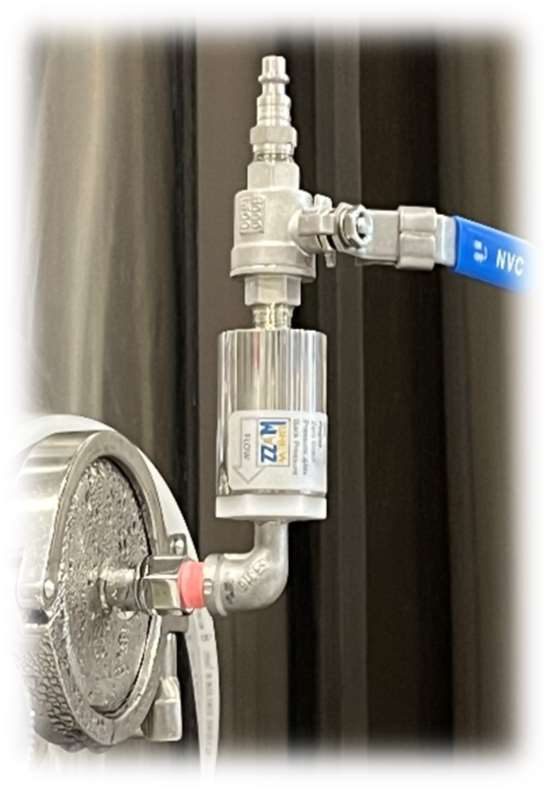
A check valve installed vertically on a tank, with the elbow leading to the carbonation stone port.
To check the isolation valve and stone once installed, see Check 7: Stone/Isolation Valve.
Replacing the duck bill valve
Remove the inner plug
Hold the stainless steel outer body and unscrew the inner plug with a wrench.
Remove the old duck bill valve
Take out the worn or damaged duck bill valve.
Clean the parts
Wash the inner plug and outer body with detergent, then rinse and dry them.
Fit the new duck bill valve
Seat the new duck bill valve in place.
Reassemble
Apply thread lock to the inner plug threads and screw it back into the outer body. Tighten by hand, then let the thread lock set. There is no need to clamp the body in a vice.
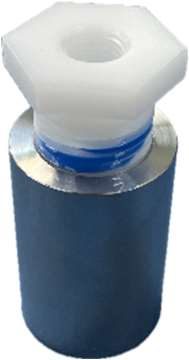
Reassembled check valve. The blue band is the thread lock on the inner plug threads.
Chemical compatibility
The ratings below are for the Delrin (acetal) inner plug, based on 48-hour exposure tests. Delrin is widely used in food and beverage equipment and has excellent resistance to most organic compounds.
Caustic cleaner test
The inner plug was exposed for 48 hours to a common caustic cleaner at 60 to 70 °C, mixed at 30 g per 1 L of water (twice the manufacturer's recommended dose). It showed no damage or discolouration.
The cleaner contained:
- Sodium metasilicate
- Sodium carbonate peroxide
- Sodium carbonate
- Tetrasodium ethylenediaminetetraacetic acid tetrahydrate
- Pentasodium triphosphate
- Isopropanol
Other ratings
| Substance | Rating |
|---|---|
| Beer, cider, wine, coffee, rum and spirits | Excellent |
| Pure neat juices and syrups | Good to excellent |
| Acid cleaner | Use at a mixing ratio of 5% or lower, and rinse after exposure |